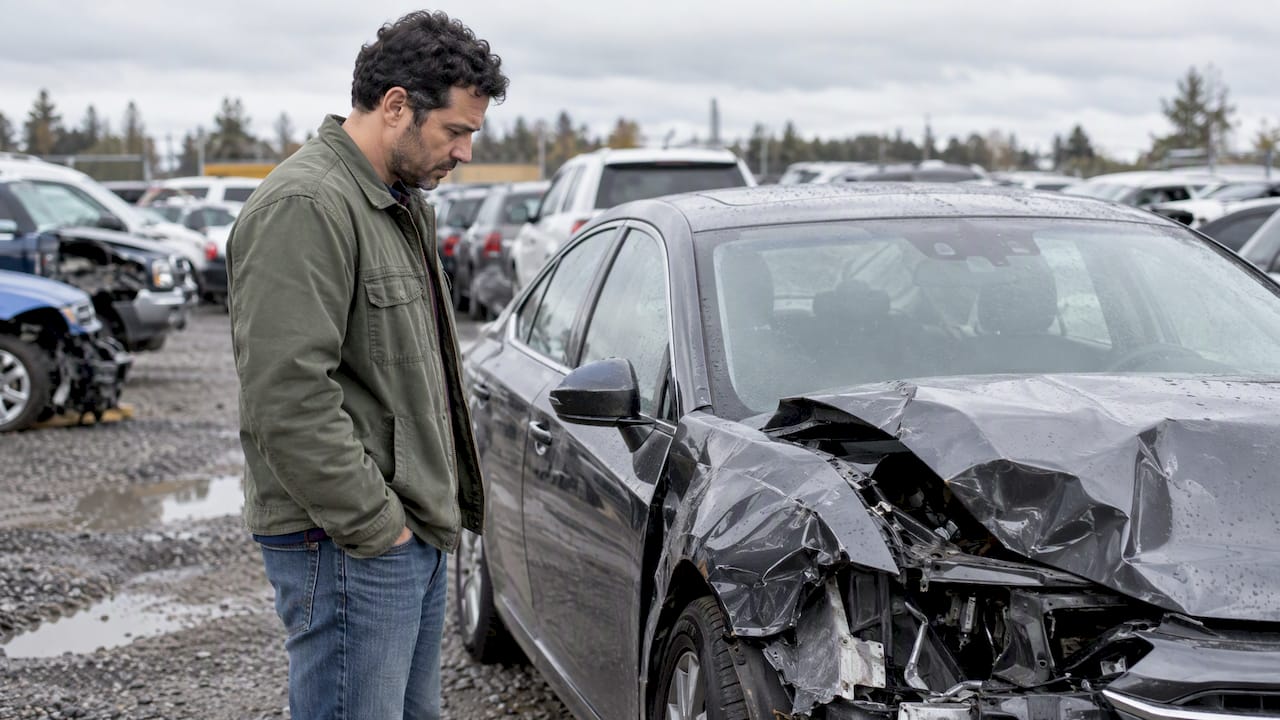
Yes, in most cases you still pay your deductible when your car is a total loss. The insurer pays the car’s actual cash value (ACV) and subtracts your deductible, the same way it would on a repairable claim. Progressive’s total loss FAQ describes this standard rule for collision, vandalism, fire and natural disaster claims, as long as you carry the right coverage. The part that surprises most drivers is not the deductible. It is how little cash is left once the deductible, the loan payoff and the replacement cost all land in the same month.
This guide shows exactly how the deductible works on a totaled car, when you might get it back, where gap coverage does and does not help, and what to do if you cannot come up with the money.
TL;DR
- A total loss payout is the car’s actual cash value minus your deductible. There is no separate “total loss fee.”
- The deductible applies whether the cause was a collision, vandalism, fire, flood or another covered event, as long as the matching coverage is on your policy.
- Gap insurance covers the loan shortfall, but it does not erase your deductible.
- If another driver was at fault, your insurer may recover your deductible through subrogation, but the timing is not in your control.
- If you cannot cover the deductible, ask about assistance before you authorize repairs or accept a settlement. We can check your eligibility for free.
Table of Contents
- How the deductible comes off a total loss payout
- When is a car considered totaled?
- Do you pay the deductible if the accident was not your fault?
- Gap insurance and your deductible
- Can you negotiate a total loss settlement?
- What to do when you cannot cover the deductible
- Our perspective: plan for the deductible before the claim
- Should you keep collision or comprehensive on an older car?
- How Deductible Assist can help
- FAQ
- Sources
How the deductible comes off a total loss payout
The math is simple. The insurer decides what your car was worth the moment before the loss (the ACV), then subtracts your deductible. What is left is your payment.
Here is a worked example with round numbers:
| Item | Amount |
|---|---|
| Actual cash value of your car | $15,000 |
| Collision or comprehensive deductible | $1,000 |
| Settlement check | $14,000 |
If you still owe money on the car, the lender is paid first. With a $12,000 loan balance in this example, the lender gets $12,000 and you receive the remaining $2,000. If the loan is $16,000, the $14,000 settlement leaves you owing $2,000 on a car that no longer exists. That gap is a separate problem from the deductible, and we cover it below.
It is not a special fee
Many drivers worry the insurer will add a charge because the car is totaled. It does not. Allstate explains that the deductible is a standard part of every collision or comprehensive claim, whether the car is repaired or totaled. It is your agreed share of the risk, set when you bought the policy.
If you have seen confusion online about fees on property damage claims, this overview of property damage claims is a useful read on the same point: the ordinary deductible is what applies, not an extra total loss charge.
Which coverage’s deductible applies
Your policy usually has separate deductibles for collision and comprehensive. Collision covers crashes with another car or object. Comprehensive covers things like theft, vandalism, fire, falling objects, animal strikes and weather. The deductible that applies is the one tied to the type of loss. Look at your declarations page before you call anyone, because the two numbers are often different, for example $500 on comprehensive and $1,000 on collision.

If you carry neither coverage, there is no deductible and also no payout from your own insurer. The NAIC consumer guide notes that state laws do not require physical damage coverage, though a lender may require it until the loan is paid off.
When is a car considered totaled?
A car is generally a total loss when repair costs, plus what the insurer could get for the wreck at salvage, exceed its ACV. Allstate describes the same test. Some states instead use a fixed percentage threshold, and the NAIC notes that insurers often work with thresholds in the 70% to 80% range of ACV, which can vary by state and insurer.
Two practical points follow from that:
- Older cars total more easily. A $9,000 car with $6,500 of front-end damage can be a total loss even though the repair looks modest.
- The deductible does not change the decision. The insurer decides total loss on repair cost against value. Your deductible only affects how much of the value you receive.
If you live in California, you may also run into salvage title paperwork if you keep a totaled car. We cover the receipts that prevent DMV delays in California salvage title rules.
Do you pay the deductible if the accident was not your fault?
If you file through your own insurer, yes. The NAIC guide states that you pay your deductible each time you claim on your own policy, even when you were not at fault. If the other driver was at fault, your insurer may pursue their insurer to recover what it paid, and that recovery is the standard way your deductible can come back to you.
You have two routes when someone else caused the crash:
- Claim against the at-fault driver’s insurer. No deductible of yours is involved, but you depend on their insurer’s speed and its liability decision.
- Claim through your own collision coverage. You pay the deductible up front, get moving faster, and wait for subrogation to possibly return it.
Neither is always better. If the other driver has no insurance or the fault is disputed, your own coverage may be the only practical path. Our article on no-fault versus at-fault deductibles walks through what you may still owe in each case. For hit-and-run losses, the evidence that can change what you owe matters a great deal.
Gap insurance and your deductible
Gap coverage is the most misunderstood piece of a total loss. It pays the difference between what you owe on a loan or lease and what the insurer pays. It does not remove your deductible. Nationwide’s gap page gives an example: with a $25,000 ACV settlement and a $500 deductible, the insurer pays $24,500, and gap then applies to the remaining loan balance after that amount.
So the order of events looks like this:
- The insurer calculates ACV.
- The deductible is subtracted.
- The lender is paid from the remainder.
- Gap, if you have it, covers the remaining loan balance according to its terms.
Some gap products and lender programs treat the deductible differently, and a few advertise deductible reimbursement. Read your contract before a claim, not after. We explain what to check in GAP insurance: check for a deductible waiver before a claim.
Can you negotiate a total loss settlement?
The deductible is fixed. The ACV is not. When a car is totaled, the figure you start from is the insurer’s valuation, and you can challenge it.
- Ask for the valuation report. The Washington Office of the Insurance Commissioner says the insurer owes you the actual cash value, and reviewing the comparable vehicles it used is the best way to spot a low offer. Insurers do not always hand over the report unless you ask.
- Bring your own comparables. Listings for the same year, trim and similar mileage in your area, plus maintenance records and recent upgrades like new tires, support a higher figure.
- Use the appraisal clause. The California Department of Insurance notes that most standard policies include an appraisal provision for disputes over a total loss offer. Read your policy to see whether yours does.
- Try mediation. California also publishes an auto claims mediation guide that lists total loss versus repair and the value of a total loss among the disputes it can address.
Every extra dollar of ACV you win is a dollar that helps offset the deductible. A $600 increase on a $1,000 deductible changes the picture noticeably.
What to do when you cannot cover the deductible
This is where most drivers get stuck. The settlement check will arrive after the deductible is taken out, so you are not usually writing a check for the deductible on a total loss. But you may still feel the squeeze, because the deductible shrinks money you needed for a down payment on the next car, and because a repair-versus-total decision can be made while you are still waiting.
There are also cases where the deductible bites in practice: a partial loss that later turns into a total loss, a rental you are paying for, towing and storage charges, or a second vehicle damaged in the same event.
Practical steps, in order:
- Confirm your exact deductible on the declarations page for the coverage that applies.
- Ask the adjuster in writing how the deductible is applied to the settlement and whether it will be recovered from another party.
- Request the valuation report and check it against local listings.
- Check for gap or lender programs before you accept a payout.
- Ask about hardship options with your insurer and your lender, and look at outside help for the deductible itself.
Our guide to five ways U.S. drivers can cover a car deductible goes through the realistic options, and six auto claim steps shows how to keep a claim moving without taking on bad debt. If a body shop offers to “waive” a deductible, read how to get written proof and find safer help first.
Our perspective: plan for the deductible before the claim
We talk with drivers after the worst day of their month: a collision, a smashed window, a flooded street, a deer on the road. What we see is that the deductible is rarely the only problem. It is the one that is due first and the one you cannot negotiate.
That is why we think of a deductible as a financial reserve. The Triple-I explains that a higher deductible lowers your premium, for example moving from $200 to $500 can cut costs meaningfully, but it only makes sense if you could pay that amount on short notice. A $1,000 deductible chosen to save on the premium is a bad trade when your savings account holds $300.
A total loss makes this sharper. Whatever the deductible is, it comes straight out of the money you need to replace the car, and replacement cars rarely cost less than the car you lost. Our advice is to know your number, ask questions early, and not wait until the shop or the lender is pressing you. If the number is out of reach, getting a case handler to look at your situation early is better than discovering the gap at the counter.
We built our service around that idea: a free, no-obligation eligibility check, a dedicated case handler for each applicant, and guidance from application to deductible payment support.
— Mikayel
Should you keep collision or comprehensive on an older car?
Once your car’s value falls, the deductible eats a bigger share of any total loss payout. On a car worth $4,000 with a $1,000 deductible, you can collect at most $3,000. The Triple-I suggests that when a vehicle is worth less than about ten times the annual premium for this coverage, the payout after the deductible may not justify the cost. That is a rule of thumb, not a rule, and it depends on whether you could replace the car out of pocket.
If you are weighing this, our comparison of keeping collision or comprehensive puts real numbers on it. Also consider that a comprehensive claim can affect your rate, which we break down in what a comprehensive claim really costs drivers over 3 to 5 years.
If you drive in Los Angeles, our auto insurance deductible explainer for LA drivers covers the local picture.
How Deductible Assist can help
If your deductible is the thing standing between you and your next step after an accident, vandalism, a natural disaster or animal damage, we can help. The process has three steps: complete a prequalification application, receive expert assistance, and secure deductible support. Eligibility checks are free and carry no obligation, and each applicant has a dedicated case handler.
You can start your prequalification on our site, or read how the three-step process works first. If you want questions to ask before you commit to any option, see these questions to ask to cover a car deductible.
FAQ
Do you pay a deductible on a total loss?
Usually yes. The insurer pays your car’s actual cash value minus the deductible for the coverage that applies, collision or comprehensive. Progressive describes this as the standard approach.
Can I get my deductible back after a total loss?
Sometimes. If another driver was at fault, your insurer may recover its payout from that driver’s insurer, and your deductible can be included. The NAIC describes this subrogation as the standard route. You cannot count on it or on its timing.
Does gap insurance cover my deductible?
Not normally. Gap pays the loan balance left after the insurer’s payment, and the deductible has already been subtracted by then, per Nationwide’s example. Check your own contract, since terms vary.
Is a total loss offer negotiable?
Yes. You can ask for the valuation report, submit comparable listings, and use an appraisal clause if your policy has one. The California Department of Insurance points to the appraisal provision for disputes over the amount offered.
Sources
- Total Loss Claims, Progressive
- Totaled Car: What Happens Next?, Allstate
- Automobile Insurance, NAIC
- Gap Insurance Coverage, Nationwide
- What happens after your car gets totaled, Washington Office of the Insurance Commissioner
- So You’ve Had an Accident, What’s Next?, California Department of Insurance
- Auto Claims Mediation, California Department of Insurance
- Nine ways to lower your auto insurance costs, Triple-I
- Triple-I
Leave a Reply