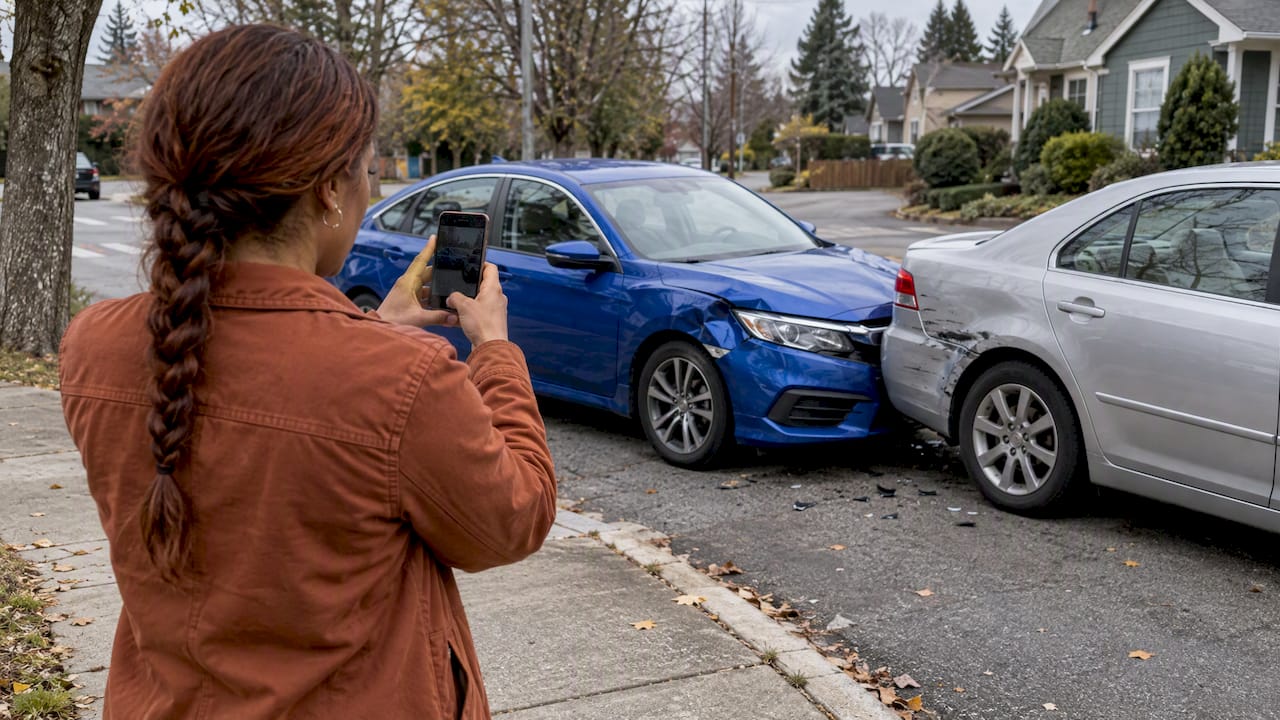
Take wide shots of the whole scene, medium shots of each vehicle, and close-ups of every dent, crack or scratch, before anything is towed or cleaned up. Add the other driver’s plate, insurance card and license, then save everything in more than one place. Those photos are the plainest proof of what happened, and they shape how quickly your claim moves and what you end up owing.
This guide covers what to photograph after a crash and after non-collision damage like vandalism, hail or flood. It also covers how to shoot safely, what to do if you missed the scene, and how to send the photos to your insurer.
TL;DR
- Shoot three distances: close-ups, medium views and wide shots of the scene, as long as it is safe to do so.
- Photograph all vehicles involved, their license plates, the other driver’s insurance card and license, street signs and road conditions.
- For vandalism, fire, flood or weather damage, photograph the damage plus the surrounding conditions, and take notes.
- Take more photos than you think you need, turn on date and time stamps, and back them up right away.
- Photos also help when you are deciding how to cover your deductible, because they document exactly what repairs are needed.
Table of Contents
- Why claim photos matter so much
- First, safety: photos come second
- The shot list: what to photograph after a crash
- Three distances, one story
- Photographing vandalism, hail, flood, fire and animal damage
- Technique: getting photos an adjuster can use
- What if you could not photograph the scene?
- Sending photos to your insurer and keeping a paper trail
- Photos and your deductible
- Perspective: why we push drivers to document everything
- Need help covering the deductible?
- FAQ
- Sources
Why claim photos matter so much
Photos give your insurer something concrete to look at. One legal reference points out that they offer concrete proof of what the accident looked like and can be more reliable than eyewitness accounts, which fade and sometimes conflict.
They also help you. Taking more photos is better than taking too few, and pictures can refresh your memory when you talk with the insurer or, in the worst case, testify in a deposition or court.
You may never need most of them. But the one shot you skip is usually the one an adjuster asks about three weeks later.

First, safety: photos come second
Photos are not worth risking your life for. Consumer Reports advises that after you check for injuries and move to safety, you then gather the key information and images you need for a police report and an insurance claim.
In practice:
- Check yourself and your passengers. Call 911 if anyone is hurt.
- Move to a safe spot if the cars can be moved and it is allowed where you are.
- Only then start taking pictures.
- Skip the long-distance and panoramic shots if traffic makes it unsafe. Nolo notes that long-distance photos should be taken only if it is safe and makes sense.
If you are too shaken or hurt to take photos, ask a passenger or a calm bystander to use your phone.
The shot list: what to photograph after a crash
A smartphone is all you need. Shoot from different angles and distances, and do it before the cars are towed or debris is cleared.
Your own vehicle
Walk around the car once and capture:
- All four corners of the vehicle
- The overall damage, then close-ups of each damaged area
- The roof and the interior, especially if airbags deployed or items were displaced
- The odometer and the VIN (on the dashboard or door tag)
- Any tire, glass or light damage, even if it looks minor
The VIN, odometer, four corners, roof and interior list comes from the Canadian provincial auto insurer ICBC, whose claim photo guidance is a useful model for what an insurer’s appraiser wants to see. It is a Canadian page, so your own insurer’s requirements may differ slightly. Check your policy or app.
The other vehicles
The Texas Department of Insurance advises taking pictures of the other cars involved, including license plates and damage, and photographing the other driver’s insurance card and driver’s license. A clear shot of each document is faster and more accurate than copying details by hand while your adrenaline is up.

The scene itself
The same Texas page also suggests photographing street signs and road angles. Add these:
- Traffic signals, stop signs and lane markings near the point of impact
- Skid marks, debris, and where each vehicle came to rest
- Weather, lighting and road surface (wet, icy, gravel, potholes)
- Any visible injuries, if you are comfortable documenting them
A photo of the intersection from each approach direction can settle a dispute about who had the right of way.
Three distances, one story
Think of your photo set as a zoom lens: start wide, move closer, then go in tight. Nolo’s suggested ranges are a handy cheat sheet.
| Shot type | Suggested distance | What it shows |
|---|---|---|
| Close-up | 1 to 5 feet | Individual dents, cracks, paint transfer, broken parts |
| Medium | About 10 to 15 feet | A whole vehicle, or one side, with its damage in context |
| Long or panoramic | 20 feet or more | Vehicle positions, intersection layout, signs, traffic flow |
These ranges come from Nolo’s guide to accident scene photos. Treat them as starting points, not rules.
A few habits make the set more useful:
- Shoot the same damage from at least two angles. A shallow dent can vanish in flat light.
- Include a reference for scale. If you use a ruler or yardstick, ICBC’s appraiser specifications say the image should show perspective and be taken at an angle that displays the damage in line with the numbers. A coin or a hand works in a pinch, but a measuring tool is clearer.
- Keep photos in order. Wide, medium, close, for each vehicle, so the sequence tells a story.
- Avoid heavy filters and edits. Original files are what you want to keep.
Photographing vandalism, hail, flood, fire and animal damage
Not every claim starts with a collision, and the evidence you need is a little different. Consumer Reports says to photograph damage to your car and any other vehicles or property, and that if fire or flood damaged your car, you should photograph and take notes about the scene, including road and weather conditions.
Vandalism and theft damage
- Photograph every scratch, broken window, slashed tire or graffiti mark, wide first, then close.
- Capture the location: the street, the parking lot, the nearby signs or cameras.
- Photograph anything missing or disturbed inside the car.
- File a police report and keep the report number with your photos.
If a car was hit while parked and the other driver left, evidence matters even more. Our guide on hit and run deductibles and the evidence that can change what you owe goes deeper.
Hail, flood and storm damage
- For hail, photograph the roof, hood and trunk from a low angle with light raking across the surface so dents show.
- For flood, photograph the waterline on the body and inside the cabin, and the surroundings that show how high the water rose.
- Note the date, the weather, and what you saw. Short written notes alongside photos fill the gaps images cannot.
Fire and wildfire
If it is safe to return to your vehicle, document the damage and its surroundings before cleanup. If you are in a wildfire area, see our page on wildfire car deductible help.
Animal strikes
Photograph the damage, the road, and the location where the strike happened. Write down the time and what happened while it is fresh.
Technique: getting photos an adjuster can use
Good claim photos are boring and clear. Keep these basics in mind:
- Turn on date and time stamps if your camera or app offers them. Nolo recommends this, along with taking the same photos with and without flash or at different flash intensities when light is poor.
- Hold the phone steady and tap to focus on the damage, not the background.
- Take extra frames. Storage is cheap. Retaking a photo of a car that has already been towed is impossible.
- Record a short video walk-around in addition to stills. Some insurers accept video as part of their remote appraisal process.
- Back up immediately. Email the photos to yourself or upload them to cloud storage before you leave the scene or as soon as you are home.
What if you could not photograph the scene?
It happens: you were hurt, the car was already towed, or you only noticed the damage later. You still have options.
- Photograph what remains. Take pictures of the damage on the car as it is now, plus any marks at the location.
- Ask for other people’s photos. The other driver, a passenger or a witness may have taken some.
- Request the police report if one was filed, and keep the number.
- Write down what you remember while it is fresh: time, place, weather, what each driver did.
- Tell your insurer honestly what you do and do not have. Do not recreate or stage anything.
Our article on how to talk to an insurance adjuster after car damage walks through what to say and what to keep factual.
Sending photos to your insurer and keeping a paper trail
Many insurers’ mobile apps let you report a claim, upload photos and check claim status. Some also offer a photo-based appraisal. One insurer’s tool, for example, lets eligible customers submit photos and a short video through a web browser and receive an estimate without waiting for an adjuster appointment. Ask your own insurer whether something similar is available to you.
Whatever route you use:
- Document your contact with the insurer, preferably by email, and take notes about calls and other correspondence, as Consumer Reports advises in its claim filing guide.
- Name your files clearly, such as “rear-bumper-close-up” or “intersection-north-view”.
- Send copies, keep originals. Never delete the originals from your phone until the claim is fully closed.
- Write down the claim number on every message you send.
Photos and your deductible
Your photos do more than prove the accident. They show the extent of the damage, which affects the repair estimate and how that estimate compares to your deductible. The Texas Department of Insurance suggests that you talk to your insurance company about your options and consider your deductible, which is how much you pay before insurance pays.
If the numbers are close, these pages can help:
- Repair cost below your deductible: what to do next
- Total loss vs repair: how to decide after a crash
- Auto claim steps to keep repairs moving
- Recovering diminished value with the right documents
If a claim is denied, a complete photo set is also what you will lean on. See what to do next when a claim is denied.
Perspective: why we push drivers to document everything
Most of the drivers who reach out to us are not struggling because they did something wrong. They are struggling because a bad day turned into a bill: a collision, a vandalized car, a storm, an animal strike, and then a deductible that is due before the repair shop will start.
We see the same pattern again and again. The drivers who stay in control are the ones who documented early. A full set of photos, a claim number, and a tidy email thread make every later conversation easier, including the one about how to cover the deductible.
That is why our process is built to be simple and transparent. You complete a prequalification application, you receive expert guidance with a dedicated case handler, and you move toward deductible support. Eligibility checks are free and come with no obligation. We would rather you walk into that process with your evidence ready, because good documentation helps you move quickly from claim to repair.
Take the photos first. Worry about the money second, but do not do it alone.
Mikayel
Need help covering the deductible?
When your photos are saved and your claim is open, the next question is often how to pay the deductible so the repair can start. Deductible Assist helps drivers dealing with collisions, vandalism, natural disasters and animal damage. You complete a prequalification application, receive expert guidance, and, if you qualify, move toward deductible support. Checking eligibility is free and carries no obligation.

Start with a free eligibility check at Deductible Assist, or read how our three-step deductible assistance process works before you apply.
FAQ
How many photos should I take for a car insurance claim?
There is no official number, but more is better than fewer. Nolo’s advice is that taking more photos beats taking too few. A practical set covers every vehicle at three distances, all four corners of your car, each damaged area, plates, documents and the scene.
Should I photograph the other driver’s car and documents?
Yes. The Texas Department of Insurance recommends photographing the other cars, including their plates and damage, and the other driver’s insurance card and driver’s license. This gives you accurate details to give your insurer without relying on handwriting or memory.
What if the damage is from vandalism or a storm, not a crash?
Photograph the damage to your car and any other property, and note the conditions. For fire or flood, Consumer Reports advises photographing and taking notes about the scene, including road and weather conditions. For vandalism, add a police report number to your records.
How do I send claim photos to my insurer?
Many insurers let you upload photos in their mobile app or online claim portal, and some accept photos and video for a remote estimate. Ask your claim representative which method they prefer, and confirm by email so there is a written record of what you sent and when.
Can Deductible Assist help if I already have photos and a claim open?
Yes, that is a good time to reach out. You can start a free prequalification to see whether deductible support may be available for your situation. Eligibility and any support depend on your circumstances and on the partner organizations funding assistance.
Sources
- Car Accident Photos: What to Take and Why They Matter (Nolo)
- How to File a Car Insurance Claim (Consumer Reports)
- Were you in a wreck? Tips for auto insurance claims (Texas Department of Insurance)
- How to file your insurance claim (Texas Department of Insurance)
- Taking photos for your claim (ICBC)
- Vehicle damage image specifications (ICBC)
- How to Take Pictures After a Car Accident (Erie Insurance)
Leave a Reply