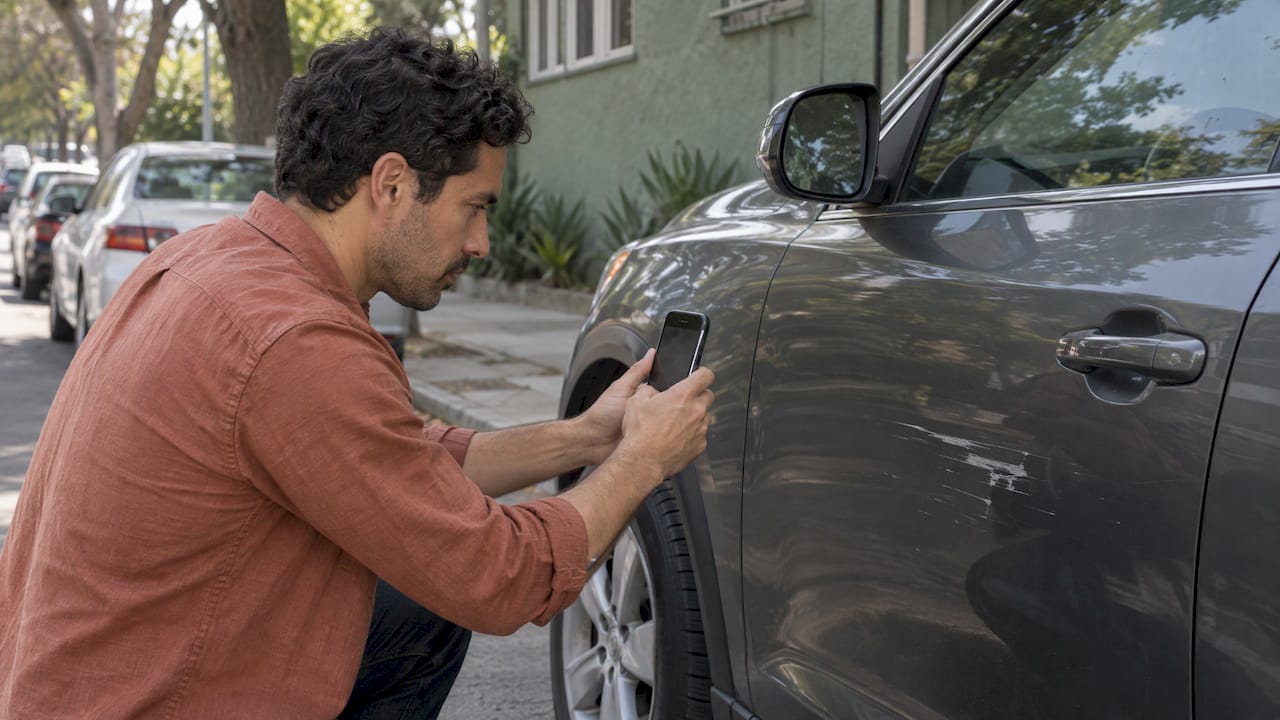
If you file under your own collision or comprehensive coverage, the deductible comes with the claim. You can still avoid paying it out of your own pocket in three ways: claim against the at-fault driver’s insurer, get the deductible refunded after your insurer recovers it, or have the deductible covered by an assistance program. We help drivers with the third route, and this guide explains all three so you can pick the one that fits your accident.
TL;DR
- A deductible applies when you claim damage to your own car under collision or comprehensive coverage. Liability coverage generally has none.
- If another driver is at fault, a claim against their insurer generally doesn’t apply your own deductible.
- If you claim on your own policy, your insurer may refund some or all of the deductible when it recovers money from the at-fault party. That can take up to a year or longer.
- For vandalism, storms, fire or animal damage, the deductible is part of your comprehensive coverage, so planning how to cover it matters.
- Deductible Assist offers a free, no-obligation eligibility check and a three-step process to help qualified drivers with the deductible.
Table of Contents
- Why the deductible exists, and when it applies
- Route 1: Claim against the at-fault driver’s insurer
- Route 2: Use your own coverage, then get the deductible back
- Route 3: The other driver is uninsured or can’t be found
- Vandalism, storms, fire and animals: no one to claim against
- Route 4: Have the deductible covered through assistance
- What happens if you don’t pay the deductible
- Will filing raise your premium?
- Know your rights during the claim
- A quick plan for the first week
- Our perspective
- FAQ
- Sources
Why the deductible exists, and when it applies
A deductible is the share of a covered repair bill that you pay before your insurer pays the rest. It attaches to coverage for your own vehicle: collision (a crash with another car or object) and comprehensive (theft, vandalism, fire, weather, animal strikes). According to Consumer Action’s auto insurance Q&A, liability coverage, which pays for damage you cause to others, generally has no deductible.
The same source gives a simple example: with $10,000 in covered damage and a $1,000 deductible, the insurer pays $9,000, subject to your policy terms. The $1,000 is your share, and the repair shop will expect it.
That is why “filing a claim without the deductible” comes down to one question: whose coverage pays? Your policy always carries the deductible. Someone else’s liability coverage generally doesn’t. Everything below follows from that.
Route 1: Claim against the at-fault driver’s insurer
When another driver caused the accident, you don’t have to go through your own policy. You can file a third-party claim, which is a claim against the other driver’s liability insurance. The New Hampshire Insurance Department’s consumer guide explains that a direct claim against the at-fault driver’s insurer does not apply your own policy deductible.
This route has real advantages:
- No deductible comes out of your claim.
- Your own collision coverage stays untouched.
- The other insurer should pay for repairs, and often for related costs like a rental car, depending on the state and the policy.
It also has a catch. You have to establish that the other driver was at fault, and their insurer investigates before paying. Evidence is what moves it along: a police report, photos of both cars and the scene, the other driver’s name, plate and insurance details, and any witness contact information. Collect these at the scene if you can.
If you need repairs started quickly and the other insurer is slow, you are not stuck choosing between waiting and going without. You can open a third-party claim while preparing a backup on your own policy. Our guide on trying a third-party auto claim for 7 to 14 days walks through how to time that, and our piece on no-fault versus at-fault accidents explains why you may still owe a deductible in some situations even when you did nothing wrong.
Route 2: Use your own coverage, then get the deductible back
Sometimes you can’t wait. The car is undrivable, you need it for work, or the other insurer hasn’t accepted fault. In that case many drivers file on their own collision coverage and let their insurer pursue the other side. This is called subrogation: your insurer pays your claim, then tries to recover its payment from the at-fault party.
The New Hampshire guide notes that if you use your own coverage you are responsible for the deductible, and your insurer may refund all or part of it if it recovers money from the at-fault party. State Farm’s subrogation page says the same in practice: it may try to recover its claim payment and all or part of your deductible when another party is primarily at fault. It also says the deductible is due to the repair shop when repairs are completed, and that recovery can take up to a year or longer in some claims.
That timing gap is the whole problem. The refund may come, but the shop wants the deductible at pickup, not a year later.
Some states put the refund into rules. Texas’s Consumer Bill of Rights for auto insurance says that when another person may be liable and you paid or owe a deductible, the insurer must pursue recovery within one year after claim payment, refund the deductible, or tell you it won’t pursue recovery and allow you to try to collect it yourself. Rules differ by state, so check your state insurance department’s consumer guide.
To give yourself the best chance of a full refund:
- Tell your adjuster in the first call that you believe another driver was at fault.
- Send the police report, photos and the other driver’s details right away.
- Ask in writing whether your insurer will pursue recovery of your deductible.
- Keep your repair invoice and proof of what you paid.
We cover the refund timeline and its limits in deductible reimbursement and subrogation.
Route 3: The other driver is uninsured or can’t be found
A hit-and-run or an uninsured driver removes the third-party route. Your own policy may still help through uninsured motorist coverage. Maryland’s official consumer advisory says this coverage applies when the other driver has no insurance, is unknown in a hit-and-run, or the other insurer denies coverage because of a policy violation. It adds that Maryland’s uninsured motorist property damage claims carry a $250 deductible set by law, that the coverage requires the other driver to be 100% at fault, and that your policy may require you to report to police promptly.
Those figures are Maryland’s. Other states set different rules and amounts, so read your own policy and your state’s guidance. The practical lesson holds everywhere: report a hit-and-run to police quickly, and document the scene. Our articles on hit-and-run deductibles and the uninsured motorist deductible cover what evidence can change what you owe.
Vandalism, storms, fire and animals: no one to claim against
If a tree falls on your car in a storm, someone keys it in a parking lot, or a deer runs into it, there is usually no at-fault driver to claim against. These losses fall under comprehensive coverage, and the deductible applies. Deductible amounts are set by your policy and, in some states, by statute. Massachusetts, for example, requires insurers to offer comprehensive coverage with a $500 deductible, an optional reduction to $300, and optional $100 glass coverage, under the statute’s conditions. Your own state and policy may differ.

For these claims, the question changes from “how do I avoid the deductible?” to “how do I cover it quickly so repairs start?” That is the situation we built our service for. Wildfire, hail and flood victims often face a deductible on top of other losses, and our wildfire car deductible guide explains what to do first.
If the damage is a cracked windshield, ask about glass coverage. Our page on prequalifying for a windshield deductible waiver shows the three steps.
Route 4: Have the deductible covered through assistance
When no other route fits, the most direct fix is to get help with the deductible itself. Deductible Assist helps drivers who are struggling to pay deductibles after collisions, vandalism, natural disasters or animal damage. The process has three steps:
- Prequalify. You complete a short prequalification application. The eligibility check is free and carries no obligation.
- Get expert guidance. A dedicated case handler is assigned to your application and guides you through the claim process.
- Secure deductible support. If you qualify, you receive financial support toward your deductible so repairs can go ahead.

You can start with the Deductible Assist application, or read how the three-step deductible assistance process works before you apply. If you are already filing, our guide to applying in three steps while filing shows how the two fit together.
What happens if you don’t pay the deductible
Your insurer’s payment is calculated after subtracting the deductible, so skipping it isn’t an option on your own claim. In practice the shop collects the deductible when it releases the car, as State Farm describes. If you can’t pay at that point, the car can sit at the shop, and storage or other fees can add up. Waiting is rarely free.
That is why the order matters. Before you file, decide how the deductible will be covered: a third-party claim, a refund you can count on, assistance, or savings. Our auto claim steps lay out six moves that keep repairs moving without taking on bad debt.
If the repair estimate is lower than your deductible, a claim pays nothing. Consumer Action says paying out of pocket may make sense when the damage is less than the deductible. Our page on repair costs below your deductible covers what to do next.
Will filing raise your premium?
It can. Consumer Action says multiple small claims could increase your rates, and recommends choosing a deductible you can afford. Maryland’s advisory says an uninsured motorist claim may affect premiums or remove discounts, while a personal injury protection claim cannot be used to increase premiums. Whether a particular claim changes your rate depends on your insurer, your state and the fault finding.
Two habits help. Ask your agent before filing how a claim of this type is typically treated in your state. And when another driver is clearly at fault, a third-party claim or full deductible recovery generally keeps the accident from costing you out of pocket.
Long term, the deductible you choose is a trade-off between premium and what you can pay after a loss. Our comparison of keeping collision or comprehensive coverage helps you weigh it, and our guide on five ways to cover a car deductible helps when a high deductible has already caught you.
Know your rights during the claim
Whatever route you choose, your state’s insurance department sets timelines and rights. Washington’s Insurance Commissioner, for example, says insurers must approve, deny or explain a delay within 30 days after a claim begins, repeat the explanation every 30 days while a claim is delayed, and respond to supplemental reports and final invoices within five days. The same page says consumers generally choose the repair shop, can’t be forced into a photo-only process, and can ask for an in-person inspection if they disagree with a virtual estimate.
If you disagree with a claim amount or coverage decision, Texas’s guidance lists contacting the insurer, talking to the repair shop, consulting an attorney, hiring a qualified appraiser, or filing a complaint with the Texas Department of Insurance. Other states have their own complaint channels, usually on the state insurance department’s website.

If you were injured in the accident, speak with a licensed attorney about your options. That is a legal question, and a deductible solution does not replace it.
A quick plan for the first week
- Day of the accident: Photograph everything, get the other driver’s details, call police if there is injury, a hit-and-run or an uninsured driver.
- Day 1 to 2: Report the claim. Say who you believe was at fault. Ask whether the other driver’s insurer has been notified.
- Day 2 to 3: Get a repair estimate from a shop you choose and compare it with your deductible.
- Same time: Decide how the deductible will be covered. If it’s a stretch, complete the free eligibility check so a case handler can start working with you.
- At repair completion: Pay the deductible to the shop, keep the receipt, and ask your insurer in writing about recovery.
If your car was damaged while parked, our parked car claim steps show the same sequence for that case. For a one-car accident, see single-vehicle accident deductible help. And for pothole damage, see pothole damage and your deductible.
Our perspective
Most drivers who find us have already learned the hard part: the repair bill is not the only bill. The deductible arrives at the same moment as the stress, the missed work and the rental car, and it is due when the shop hands back the keys.
We believe the answer is not to avoid your insurance or to stretch a credit card past its limit. It is to separate two questions. Who is responsible for the damage? And how do I cover my share today so the repair isn’t delayed? The first can take weeks or a year. The second shouldn’t.
That is why we built a simple three-step process around a free eligibility check and a dedicated case handler. You shouldn’t have to decode your policy alone while your car sits waiting. If you qualify, deductible support lets you repair now and sort out recovery afterward.
Mikayel
FAQ
Can I file a claim and not pay my deductible at all?
Not on your own collision or comprehensive coverage, because the deductible is built into how the payment is calculated. You can avoid it by claiming against an at-fault driver’s insurer, or recover it later if your insurer collects from the other side. Assistance can also cover it for qualified drivers.
If it wasn’t my fault, do I still pay a deductible?
Only if you go through your own policy. A direct claim against the at-fault driver’s insurer generally doesn’t apply your deductible. If you use your own coverage to get repairs moving, your insurer may refund all or part of the deductible once it recovers money from the other party.
How long does it take to get my deductible back?
It varies. State Farm says recovery can take up to a year or longer in some claims. Texas requires its insurers to pursue recovery within one year after claim payment, refund the deductible, or tell you they won’t pursue it. Your state’s rules may differ.
What if my car was vandalized or damaged in a storm?
There is usually no at-fault driver, so the claim goes under comprehensive coverage and the deductible applies. Get your repair estimate, file promptly, and plan how you will cover the deductible. Deductible Assist can check your eligibility for free.
Sources
- Consumer Action: Questions and Answers about Auto Insurance
- New Hampshire Insurance Department: 2022 Automobile Insurance Consumer FAQ
- Texas Department of Insurance: Consumer Bill of Rights, auto
- State Farm: Subrogation and Deductible Recovery for Auto Claims
- Maryland Insurance Administration: Consumer Advisory on Uninsured Motorist Claims
- Washington Office of the Insurance Commissioner: Filing an auto insurance claim
- Massachusetts General Laws, Part I, Title XXII, Chapter 175, Section 113O
Leave a Reply